As a bookseller, my top favorite job responsibly is reading. In my line of work, it pays to be well-read.
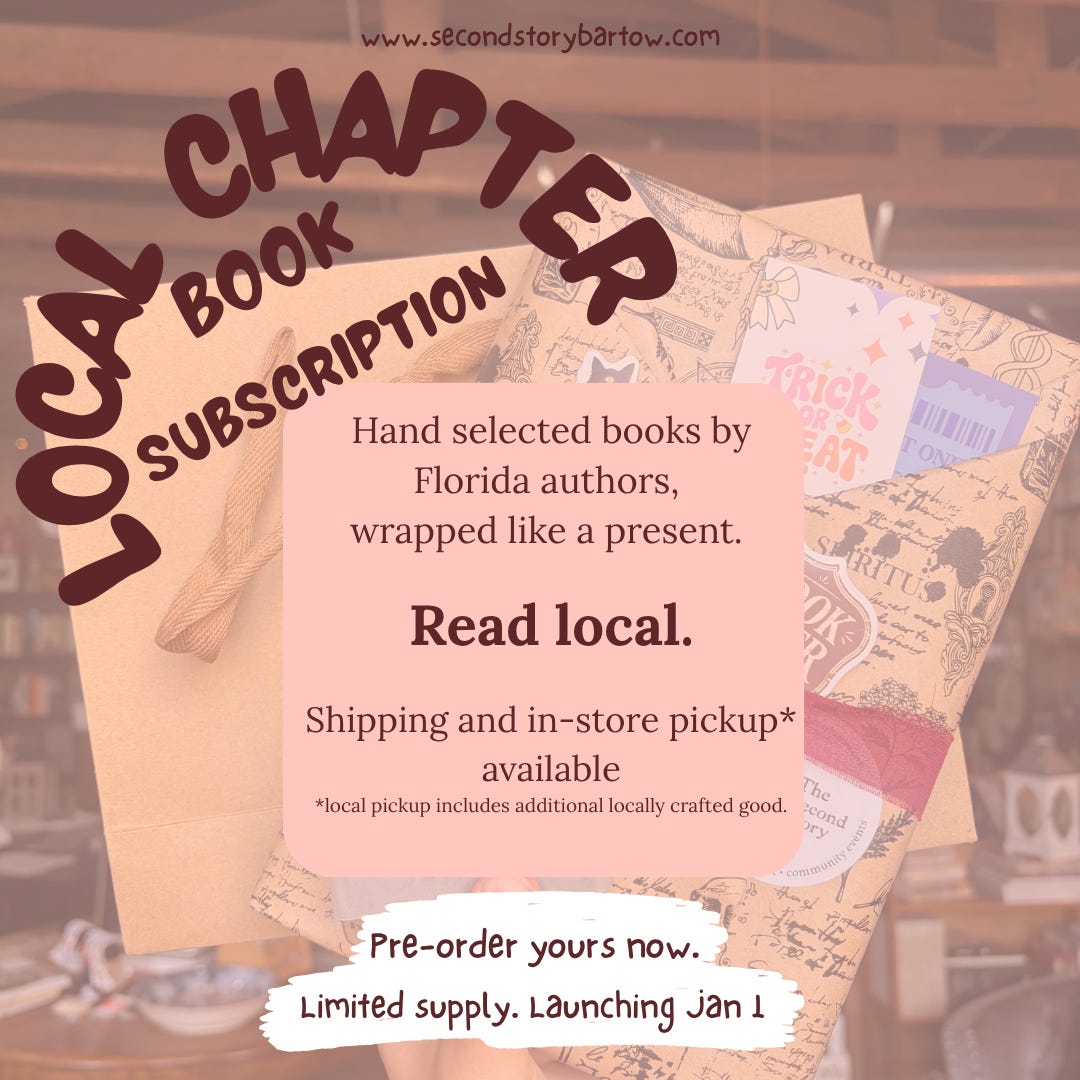
My current reading project is focused on Local Authors (local being anywhere in Florida). The Second Story is launching a subscription box called Local Chapters, which will offer a curated collection of books by Florida authors to readers. You can pre-order now, as we have a cap of 25 subscriptions for the first four months.

Luckily, the first book I read for this project was The Daunted Dastard by K.E. Monteith, a sports romance set in Daytona. This book gave everything a romance needs. Longing, miscommunications, angst, supportive friends, and sexual tension. I loved it from the first page.
If you decide to subscribe to Local Chapters, (spoiler alert) you’ll be getting this book sometime next year. I’m so excited for you to read it.
Until then, you’ll have to make do with this insightful interview with K.E. Monteith. She is an expert in indie publishing (releasing her 14th book in a few weeks) and has a lot of insightful advice about the business of indie publishing while holding a day job, as well as best strategies for marketing and distribution.
Interview with K.E. Monteith

SM: You’ve been writing and self-publishing for a long time. In fact, your 14th book, The Devoted Dastard, will be released on October 20th. You mention in the acknowledgements of The Daunted Dastard (your 13th book) that it was the first time you could pay an editor and cover artist. Can you talk about the difference in your production process? Have you seen a difference in the way readers experience this book as compared to previous books?
KEM: My process has involved a TON since I started, particularly the drafting process. I used to not outline and you can tell when I started just based on the page lengths of my first few books. I’ve also found a better work flow for myself and have the literal data of how much I can write in what kind of situations, which is only something you can get years later. Having that data helps me plan ahead a lot, in terms of knowing when to hire contractors for future projects (talented folks are rightfully booked so far out, you really need to get on their calendars ASAP). And now that I’ve outlined and, more specifically, outlined all the books for a series before writing book one, I can add easter eggs, which I think is the biggest betterment to the reader experience. My favorite thing is getting comments like “oh is X getting a book” because it hypes me up to write.
SM: Publishing a book really is a collaborative effort. Where have you been able to find your contractors and what has your experience been like? I ask because many indie authors are struggling to find contractors that are both affordable and do not use AI. Are you at all concerned about AI use from an editor or cover artist?
KEM: A lot of my contractors I’ve gotten from recs from other authors or from looking at who authors I look up to work with or even looking at people’s posts I like and seeing if they do work (really only applicable in the case of graphics). I’ve been pretty fortunate in finding people that already have anti-AI policies in their contracts/sites and that’s what I’ll be looking for when working with anyone new.
SM: What led you to self-publish your novels? If you could go back and do it all over again, what would you do differently?
KEM: Like millions of others, I really got into KU romances during 2020 and all those books I devoured recharged my creative energy and inspired me to follow in their path. The only thing I’d do differently would be starting cross-platforming immediately. I started out on TikTok because that was the platform I used as a reader, plus with starting everything, I wanted to keep it simple. But I think crossposting, even just the exact same videos, could have been helpful.
SM: How many of your sales are KU as compared to physical copies of your book? How do you get your book seen on KU?
KEM: KU sales are the vast majority of my royalties, followed by wholesale orders from indie shops. While there are definitely things you can do with SEOs in Amazon to boost KU views, I focus on social media presence or passing out bookmarks that lead to KU at events.
SM: Many authors are discouraged by having to develop social media platforms to sell their books. How did you build your platform? What advice would you give authors just now building a platform?
KEM: I built my platform mostly by trial and error, testing what I liked, trying my own version of trends. My advice would be to look at an author you compare to and look at their platforms as a reader and an author and build off what you learned from that.
SM: What is your marketing strategy? How do you know what to post, when? How did you develop a brand identity?
KEM: At this point, I don’t hold on too closely to a marketing strategy because of how quickly trends and the algorithm changes. I have a formula for when to do trope, cover, etc reveals based on the pub date, but beyond that I keep my plans flexible. Right now, my brand identity is saved for static posts on Instagram so that when someone clicks on my profile they get a clear idea of me and my books (highly recommend utilizing a banner!) I keep my reels off the main page and am currently posting a lot of trial reels that crosspost to Facebook and Pinterest, using character art, which has gotten the most traction lately.
SM: It sounds like you use your main page for brand association and information, whereas your reels go out into the world and catch you new readers. What would you say is the breakdown of how much time you spend working on social media vs writing?
KEM: The ratio depends on where I’m at with my writing. After edits are completed and before I start on my next book, I spend that vast amount of my “author” time on admin/social media stuff, like bulk creating reels. I tend to over create during this time so that when I’m working on another project, I can pull from that and post. And with trial reels especially, reposting content isn’t a bad thing, the algorithm is targeting people who hadn’t seen your content before.
SM: As far as marketing, which serves to produce the most sales? Social Media marketing? Email Newsletters? Author website? Something else?
KEM: Social media, without a doubt. It’s where the readers are.
SM: I noticed in December of 2024 your social media shifted to have a much more cohesive brand identity around the Snowfall Valley Series. Can you talk to me about social media marketing? What was your learning process like and has building a cohesive brand increased your reach?
KEM: When I got started in 2022, my bread and butter was TikTok quote videos. I think across all my platforms, those still have the best views and saves of anything else I’ve ever done. But those videos stopped getting engagement and the subsequent page reads I saw with my first release. So that’s when I pivoted and started an Instagram, which definitely needs a more consistent visual. It was also easier to build an aesthetic around a series versus stand alones and even easier to pick a tag line when I had a few books under my belt and could ask myself what they all had in common. I’m not sure my more cohesive look has gotten me more reach in terms of readers, but I do think it makes a difference when partnering with bookstores. When you’re investing in your business, whether that’s hiring a contractor or learning a new skill to do it yourself, others are willing to invest in you.

SM: I am really intrigued by that last statement. How much of your time and energy do you spend developing partnerships with bookstores as opposed to selling directly to readers? Do you feel those partnerships are beneficial to you? Why or why not?
KEM: Of my admin time, I’d say about 25% of it is spent researching and reaching out to bookstores or submitting to their forms to get my books in shops. There are plenty of readers that aren’t regularly on social media and the best way to reach them is to get on shelves they can see.
The Writing Process
SM: Can you talk to me about your writing and revising processes?
KEM: I am a comparatively slow writer. Day job days, I don’t tend to get more than 800 words in and on weekends, 2k is my cap. Part of the reason is that I don’t skip scenes and I prefer to sit on something than push through it. The trade off to this is I don’t tend to make big revisions in terms of adding or changing plot. But everybody’s brain works differently, figure out what works for you now and don’t be afraid to try different techniques when you’re stuck.
SM: You mentioned earlier that you have become more of an outliner over time. What does outlining your novel look like? Do you use index cards, an app, a spreadsheet? How close is that outline to the final book?
KEM: I use a Notion template that’s a mix of Save the Cat’s beat sheet, Story Genius notes, and other tidbits I’ve picked up along the way. My outline is just a series of brief bullet points, just enough to get the scene ideas across, and sometimes sub points for quotes I want to fit in. I don’t keep to the outline exactly, but it gives me better direction to know what scene is coming next while I’m writing. But the best part of outlining is that I have a formula for a synopsis based on the outline.
SM: Do you have a strong writing community? How did you build that and what does it look like?
KEM: I’ve built up author friendships, mostly through commenting on social media or joining author group chats. It’s mostly to lift each other up, provide space to vent, and give each other advice.
SM: Can you name one author friend that has made a big impact on you as a writer? Where can we find them? What do they write?
KEM: I don’t think any of my friends have changed me as a writer. But Ambar Cordova and Chelsea Curto are both two positive rays of sunshine that inspire me to grow and share/encourage others more. Both are contemporary romance authors.
SM: Which book of your own are you most proud of? Why?
KEM: I think this will almost always go to my most recent book, I’m always learning new tricks to work with my brain, make the process easier/smoother.
SM: On the hardest days, what is it that keeps you coming back to the page?
KEM: Writing things that make me (and hopefully others) laugh, it’s become my favorite thing and hitting those bits makes editing much more fun.

If you want to keep up with K.E. Monteith, find her on Discord, Instagram, or subscribe to her email newsletter.
Thank you for taking the time to read this email. I would love to hear what you want to read about. If you’re an indie author, message me with topics, questions, or concerns you would like me to explore in future newsletters.
Know an indie author? Tell me about them in the comments.
Who should I interview next?


Leave a Reply