The day by day by day by day tasks that lead to a first draft.
I wrote a book.
It is a very bad book, with plot holes and typos and major issues with the P.O.V., but I wrote a book. I typed the last line on Monday, just after the sun went down and the mosquitoes came out.
I started it last October, thinking I could finish it in 90 days (Alan Watt told me I could) but I did not meet that goal. And then came the first semester back in grad school, and then summer with the kids, and then and then and then… no book.
There is a small sliver of space between being the person who wrote a book and the person who wants to. That sliver is all patience and effort. The days pile up.
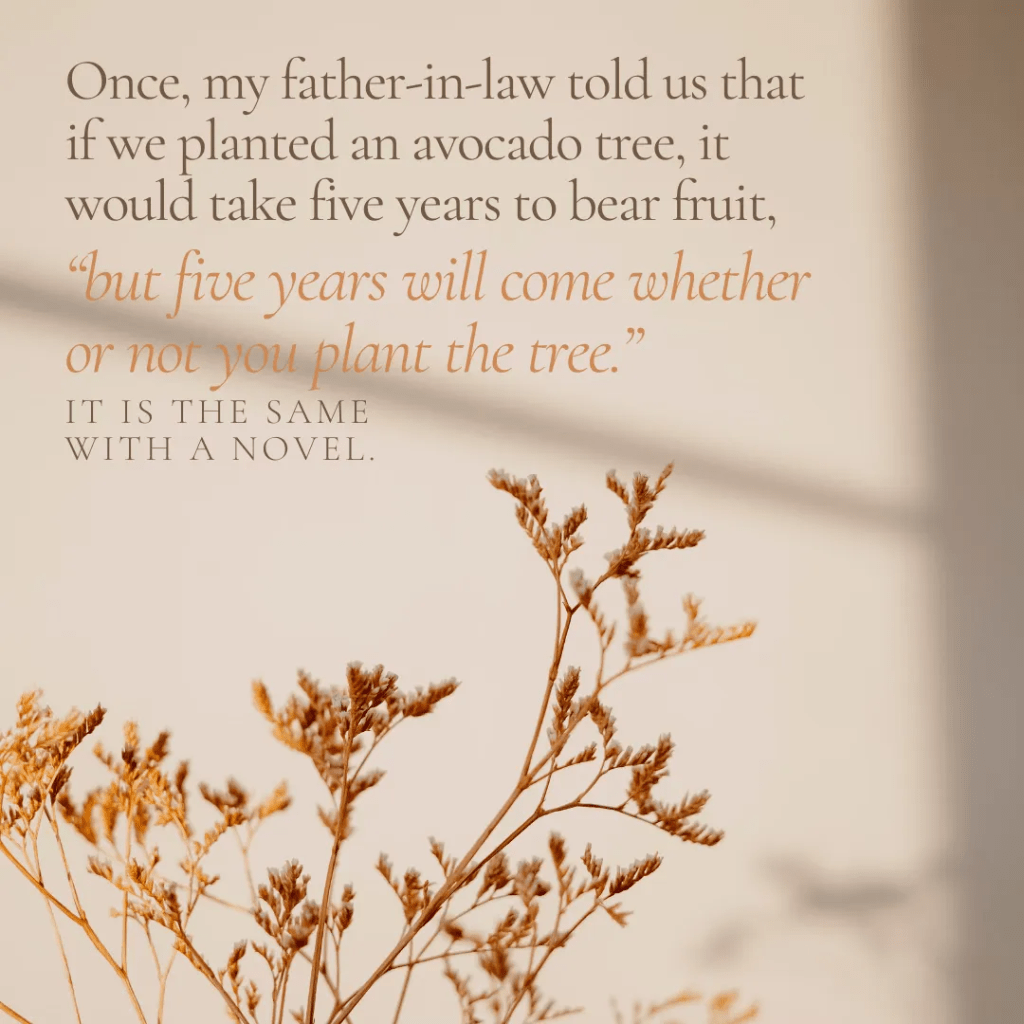
Once, my father-in-law told us that if we planted an avocado tree, it would take five years to bear fruit, “but five years will come whether or not you plant the tree.” It is the same with a novel.
I carved out a book one sentence at a time, sometimes drafting a thousand words, most days more like fifty, and I learned what it looks like for me to write a book. I cannot tell anyone how to write their book, but I will say that the advice to “just do it” is the worst advice I’ve ever been given, and at the same time, in hindsight, it is true.
In spite of the badness of my book, the raw shape it is in, the hairy first draft of it, I want to inflate my own ego by sharing what I learned in the process. Or, perhaps I am sharing to keep record of what I learned, to look back on when the next first draft feels daunting.
I am not sharing advice, exactly, as what I did may not work for you, but it did work for me, and maybe it can help. Ultimately, I hope more people will write books and run-on sentences and poetry and uncomfortably vulnerable Facebook posts.
20,000 steps to writing your book, summed up in five points:
Because I was obsessed with reading craft books that laid out exact plans, and because none of those plans showed me that I would need to take 20,000 individual steps, day after day, sometimes real actual steps, to complete the draft.
- Be poor. Like no-McDonalds, the-power-went-out poor. When you’re poor, your time gains weight. If you’re not working, you’re spending, and if you’re spending, you’re threatening your very livelihood, so every action must be towards something. This is a terrible way to live, but a wonderful way to drive yourself forward.
- Go for walks, or runs, or buy a jumprope or set a goal of fifty jumping-jacks a day and do everything you can to meet that goal, not your writing goal.
- Once, in the heat of the summer, I set a goal to take 20,000 steps a day. Imagine all the hours spent walking, not writing! Yet, on the days I met that goal, I found in myself the energy to wash the dishes, to clear the table, and, yes, to write. When I didn’t walk, I didn’t write, and the dishes piled up, and crumbs collected on the table, and everything was very, very bad.
- Movement is essential. Writers are walker and runners and paddle-boarders. They move about the earth slowly, with their eyes open to wonder. If you move, you will write, it is inextricably linked. Who could know why?
- Set your goal in public, but keep your story private. Most of us are externally motivated. That is fine. Tell enough people that you will be embarrassed to not meet your goal, but don’t tell them your story because you don’t yet know your story. If you tell your best friend that you are writing historical fiction and what comes out is fairy smut, you will feel wholly embarrassed about your lies. If you don’t tell them your plans, you can just impress them with your fairy smut.
- Keep a tight timeline. But keep it reasonable.
- Originally, I set out to write 60,000 words in 90 days. I ended with less than 10,000, probably. Over the next few months, I gathered another 20,000, but they were awful. It’s good to write awfully, to give yourself permission to write terrible words. In September, I decided to write 1,000 words a day for 30 days to finish my novel. This was a hard goal, but not too hard, because I gave myself permission to make foolish mistakes and write badly and the only goal I needed to meet was 1,000 words, even if I knew I would cut all 1,000 later. Halfway through those 30,000, I realized that my main character was a dud, and I will have to rewrite the first 45,000 words without her. I pushed forward. Looking back will turn you to stone. Don’t worry, second-draft you is a super hero who will not be daunted by a 45,000 word rewrite. She wrote a book. She can do anything.
- Celebrate the process. Celebrate finishing. Celebrate the effort and the time and the resiliency it took. You are not celebrating the book. It is a bad book, and that is a good thing. You are celebrating the writing process.
- If you ever want to write another book, you must trick yourself into loving the work of writing. It is work, the hardest work, because you are creating matter out of nothing but electricity in your brain. You are building worlds from ideas and forming people from impressions. This is joyful, but it is painful. If you decide to love the ugly first draft, good for you, but if you love it more than the act of writing, you are committing to dread. Good stories have defined beginnings, middles, ends. Writing does not. It drudges on into eternity, none of it wasted but much of it cast aside.
As I said, this will not help you to write your book. Nothing can help you do that. Time and space will work on you until you become ready for the task. I spent twenty years miserable that I hadn’t already written one, and then, when I finally realized it was inevitable and I pushed that doom aside, I wrote one.


 sarina r michel
Leave a comment